


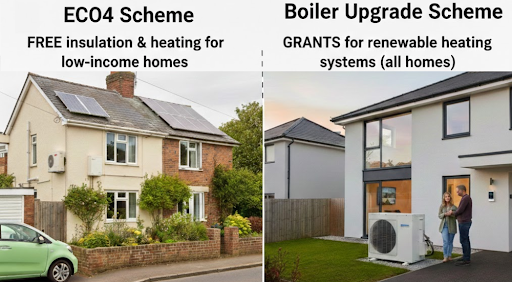
Both the ECO4 and BUS schemes were launched in the UK to help vulnerable households heat their homes at lower or zero upfront cost. Through these schemes, the UK government gets energy-efficient heating systems installed for those who can not afford or are at risk of fuel poverty.
Energy efficiency has been a major issue in the cold weather of the UK. Low-efficiency systems lead to higher energy bills and more carbon emissions, and the government is trying to sort both these issues at any cost.
However, despite serving the same purpose of improving energy usage, they are different for several reasons, such as objectives, audience, and implementation. This article will compare ECO4 and BUS and find out some fundamental differences between the two.
ECO4 Scheme Fundamentals
Energy Company Obligation grants are available for England, Wales, and Scotland residents who are struggling to keep their homes warm and pay their energy bills. ECO4 grants work on a “whole house” approach where all the energy efficiency measures are taken for the low-income and low-energy efficient homes, all paid by the energy companies under obligation placed on them by the government.
These grants play a crucial role in alleviating fuel poverty and reducing the carbon footprint caused by residential heating systems.
Eligibility Criteria
To be eligible for ECO4 grants, the homeowners, private tenants, and landlords must meet the following criteria.
- Benefit Recipient
- Household Income Lower than £31000/annum
- Homeowner or Tenants With Permission
- Boiler Installed Before 2005 (Non-condensing)
- Gas Meter Installed Before April 2022
- Eligible Property Style
- EPC Rating D or Lower
These are the basic eligibility criteria. However, eligibility can be dependent on various other factors. You can consult a reliable installer like Eco Energy Services and ask them to survey your property and help you decide your eligibility accordingly.
Upgrades Covered Under ECO4
Here are the major measures that are fully covered under the ECO4 scheme.
- Free Boiler Replacements and Installations (Combi, system, and regular boilers as per the requirement)
- Free Air Source Heat Pumps ( air-to-air and air-to-water heat pumps are installed)
- First Time Central Heating Boilers, Radiators, Pipework, Fittings, Valves. Additional Improvements to Insulation.
- Insulation Grants: Loft insulation, cavity wall insulation, underfloor insulation, and room-in-room insulation.
These four major upgrades are covered under ECO4 grants.
Overview of Boiler Upgrade Scheme (BUS)
Other than this, another scheme of the UK government to uplift the adoption of low-carbon heating systems is the Boiler Upgrade Scheme. In addition to that, such grants are also provided to low-income and low-energy-efficient homes, which helps to keep their homes cosier and reduce energy consumption and costs. BUS specifically prefer those at risk of fuel poverty and can’t afford energy-efficient heating systems.
Its main objective is to reduce dependence on fossil fuels and contribute towards the country’s net-zero target for emissions. The BUS scheme is designed to make greener heating systems more accessible to homeowners and landlords in the UK by providing financial incentives.
Eligibility Criteria:
The eligibility criteria for the BUS scheme are quite simple compared to the ECO4 scheme. Here are the details;
- Location: The property must be located in England or Wales.
- Existing System: BUS applies only to retrofitting properties with existing fossil fuel or electric heating systems.
- EPC Requirements: The property should have a valid Energy Performance Certificate issued within the last 10 years.
- Property Type: The property should be of an eligible type; newly constructed properties are ineligible.
Upgrades Covered Under BUS
These are the upgrades usually covered under the Boiler Upgrade Scheme:
- Air source heat pumps, except air-to-air systems.
- Ground-source heat pumps – including shared ground loop.
- Biomass boilers are only for rural properties which have not been connected to a gas grid.
Which Scheme is Right for You?
Choosing between the ECO4 Scheme and the Boiler Upgrade Scheme (BUS) depends on your specific circumstances and energy goals:
When to Choose ECO4
- Eligibility: Ideal for households on income-related benefits or with low Energy Performance Certificate (EPC) ratings.
- Scope: Provides comprehensive energy efficiency upgrades, including insulation and heating improvements.
- Focus: Reduces energy poverty and improves overall home energy efficiency without upfront costs for eligible participants.
When to Choose BUS
- Eligibility: Homeowners or landlords willing to install an alternative heating system to fossil fuels.
- Technology: low-carbon solutions, such as heat pumps or biomass boilers.
- Financial Investment: between £5,000 and £7,500 grants to offset the costs of installation.
Assess your property’s needs, eligibility, and sustainability objectives to make an informed choice
Conclusion
To wrap up the discussion, both the Energy Company Obligation and Boiler Upgrade Scheme are initiated by the UK government for low-income households to reduce their energy bills and help them be more comfortable. They also support the UK government’s goal of net-zero carbon emissions and reducing fuel poverty.
Both these schemes offer different upgrade measures under different eligibility criteria. In this article, we have compared both grants and answered which can be a better choice for you, as per your household requirements.
