


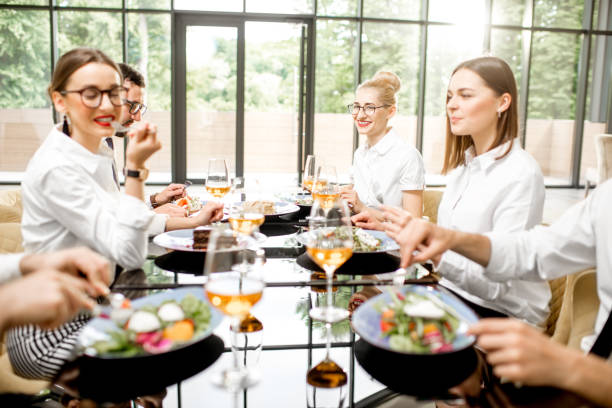
In 2026, group dining will be an ever more significant experience in the restaurant. Families, friends, colleagues and social groups are seeking comfortable places, where they can have good food, and also spend valuable time together. The change is backed by recent dining statistics: group dining of six or more people grew by 11% annually in the United States, and 36% of Americans would prefer to see more group and private dining in 2026.
In the case of restaurants, bigger parties present both opportunities as well as challenges in operation. Eight or twelve guests make a good money table and to serve a huge number of guests, a lot of planning is necessary. Restaurants are thus shifting the layout, menu, reservation system and style of service to ensure that larger gatherings become easier to handle.
Flexible Restaurant Spaces Are Becoming More Important
The shift to flexible eating areas is one of the most evident tendencies of 2026. The restaurants are also coming up with interior designs that are capable of accommodating various party sizes without leaving smaller groups uncomfortable.
Tables that can be moved, modular sitting, private dining rooms, and flexible floor plans enable restaurants to consolidate tables in case a bigger group comes. The method assists businesses to utilize the space they have more effectively and provide customers with more flexibility.
Flexible layouts are more in particular to restaurants that will be used to celebrate birthdays, anniversaries, business dinners, family celebrations and other parties. A couple sitting at lunch can have their space moved to a group dinner in the evening.
The current reports on the design of restaurants also indicate that convertible layout is a viable method of accommodating both casual groupings and personal events.
Large-Party Reservations Are Getting More Attention
Reserving a two-seat table is fairly easy. It can be a lot more complex to reserve a table with ten or fifteen people. The response by restaurants is to make large-party reservation more structured.
Numerous restaurants now require prior reservations, confirmation information, a deposit or card hold on larger reservations. These are used to pre-plan employee training, seating patterns, food products and schedules of service before the arrival of customers.
Diners also get the benefit of this trend. Definite reservation policies minimize uncertainty and make groups aware of what to expect prior to their visit.
This increase in the size of parties, makes the management of reservations especially crucial. The 2026 study by OpenTable suggests deposits and credit card holds as means by which restaurants can secure against last-minute cancellations when it comes to large-party bookings.
Private Dining Is Becoming a Bigger Part of the Experience
Dining is not a privilege of the formal corporate events or the costly celebrations as it has been before. Social gatherings like birthdays, reunions, engagement celebrations, team dinners, and other social gatherings are increasingly being hosted in the restaurant using private or semi-private space.
The appeal is simple to comprehend. Groups wish to discuss, feast, and have fun with their meal without the disturbance of the main restaurant.
Restaurants can also use private spaces to make their experience more personalized. A group may have a special menu, exclusive service, personalization of table setting or a chef-hosted experience.
With more diners perceiving restaurant visits as more of an experience than merely a meal, private dining provides restaurants with an additional means to make bigger gatherings unforgettable.
Restaurants Are Developing Group Menus
It takes more than making a number of separate orders to the kitchen to serve a large party. Restaurants are also considering ways in which menus can be group friendly.
Ordering can be simplified by using family-style options, prix fixe menus, tasting menus, and preselected courses. They also assist kitchen teams to plan ingredients and preparation in a better way.
Meanwhile, restaurants should understand that when a group is eating together, it does not imply that everybody is interested in the same food. The 2026 study by OpenTable revealed that half of the American population prefers to have their own meal instead of sharing with the table.
That gives an interesting balancing. Restaurants may provide their guests with convenient group packages and still provide them with the option of making a personal choice in case they have a different taste or dietary needs.
Technology Is Making The Management of Large Groups Easier
The other significant aspect of restaurant operations in 2026 is technology. Online reservation systems, contactless payments, online ordering, customer information systems, and integrated restaurant technology can alleviate part of the stress that large gatherings may cause.
As an illustration, a restaurant will be able to gather data concerning the number of people in a party and any special requests before the arrival of the guests. Employees are then able to make tables and arrange service pre-emptively.
Payment technology comes in handy too. Division of a bill among eight, ten or twelve individuals can be a frustrating way to conclude a pleasant meal. Online payment methods will provide more flexibility to diners and allow employees to close big checks in a shorter time.
Technology in restaurants is becoming more about practical operational enhancements as opposed to technology itself. Examples of this broader shift include connected systems of payments, ordering, reservations, labor, inventory, and analytics, which are discussed in industry reporting in 2026.
Personalized Service Matters More for Larger Parties
Sometimes large groups are served slowly or less personally due to the fact that employees are to serve a number of guests at the same time. Restaurants are reacting and are more focused on the group experience.
Some of the factors that can make a difference are dedicated servers, effective communication between front of house and kitchen staff and prior knowledge of celebrations.
Personalization may be rudimentary. Guests can feel taken care of by remembering a birthday, making a requested seat set up or knowing that a group requires separate checks.
This is important since group meals are usually related to significant occasions. The guests might recall how the restaurant was able to manage their celebration with ease as much as they can recall the food.
Experiential Dining Is Influencing Group Gatherings
Experience dining is another big trend of 2026. According to OpenTable, there was a 46 percent year-over-year growth in experiential dining and 36 percent more Experiences on restaurant menus in 2025.
The given trend is more consistent with bigger groups. Themed dinner, tasting, pop-up, or special collaboration offers a chef with a table to friends and family members to share.
These events can be utilized by restaurants to generate occasions that customers can come together in addition to the average dinner bookings. Repeat visit can also be encouraged by the shared experience especially when the experience is seasonal or limited.
As a group, another benefit of experiential dining is that it provides the group with a focus. Guests are not just going to dine together, but are attending something.
Value remains essential
Even though value will be a great factor when customers desire memorable dining experiences, in 2026, value will be a significant consideration. Restaurants should be able to offer a group service in a way that it is worth it yet not on the quality.
Premeditated price menus, early night deals, special packages and properly calculated portions can make customers know what they are getting into their pockets.
According to the 2026 report by OpenTable, value is one of the biggest restaurant trends, with happy hour and other value-driven events gaining popularity as customers seek to make their outings worthwhile.
In the case of restaurants, it is not always important to provide the lowest-priced meal. Rather, effective group dining can be based on convenience, quality, atmosphere, service and the overall experience.
Restaurants Are Architecting Social Connection
The core of the group dining trend is that it cannot be substituted by technology: people like spending time together.
OpenTable discovered that three out of every five Americans believe that going out to eat is one of the ways to feel connected to other people. In the same study, it was discovered that 40 percent would prefer to sit and eat with a group as opposed to eating alone.
This is the reason why restaurants are becoming more accommodating to large tables, intimate areas, versatile seating and communal experiences. The restaurant is turning out to be more than a food buying destination. It is emerging as a place of discussion, feast, and bond.
What Restaurants Can Expect Next
The trend of eating as a group is expected to affect the restaurant planning in 2026 and further. Those businesses which facilitate easy booking, comfortable seating, easy ordering and easy payment of large parties can achieve a better overall guest experience.
Probably the most thriving restaurants will integrate adaptable rooms with considerate menus, effective technologies, customized service, and experiences that provide individuals a purpose to come together.
To diners, this implies that bigger groups are to be given more options than ever. With the family dinner, birthday party, corporate lunch, or even an evening out with friends, restaurants are making customizations to accommodate larger groups.
Conclusion
Dining as a group is enjoying a resurgence in the year 2026 and the restaurants are reacting to this by modifying their spaces as well as to their service approach. Flexible designs, personal dining spaces, high-party booking policies, groupable menus, online payment services, and personalized services are gaining significance.
The trend can be attributed to a larger longing of connectivity. With individuals seeking something meaningful beyond the home, restaurants gain a chance to simplify, comfort, and enhance group events. To the businesses that are ready to evolve, serving mass crowds may be a significant aspect of the contemporary dining experience.
