


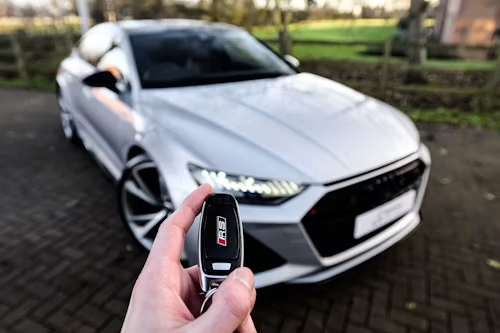
Some of the worst mistakes on car bodywork that can greatly decrease the value of a used car are bad DIY repairs, paint that doesn’t match, rust being ignored, and lots of filler work that any buyer or evaluator at a chain of stores can easily identify. A lousy repair might often reduce the value even more than the initial damage, simply because it communicates neglect and makes one wonder what other parts might be messed up. Buyers tend to be more understanding of natural wear and tear than a repair that has definitely been done incorrectly.
One main reason why this is so important is that bodywork is the very first thing anyone will judge. A buyer will have made a decision about a car within the first thirty seconds of simply walking around it, long before they would normally take a look at the service history or check the engine, and a panel that reflects the light in a very strange way or a small rust spot can make a buyer see everything in a negative light. If you get the exterior finish wrong, you are already at a disadvantage when it comes to bargaining before even saying a single word.
Botched DIY Repairs That Cost More Than the Damage
One of the most costly mistakes a person can make is to carry out the repair in such a way that the resulting look of the repair is even worse than the initial damage it was trying to fix. When it comes to stone chips, there is very often a layer of quite thick touch-up paint covering the chips. Besides this, when a paint can is sprayed at a distance produces an orange-peel effect and overspray makes its way onto the trim or glass, these are all signs of very poor, amateurish work, and a trade valuer will very likely think something very bad about all the things he or she will be unable to see. Even if the scratch itself is only of the value of 200, a disorganized and grossly mishandled repair can easily knock several hundred pounds off the final offer simply because it shakes one’s confidence in the entire car.
The most common hint that a job was done by the wrong person and it was very badly done is a color mismatch. The fast way to mess up the color is to ignore the manufacturer’s paint code and make a blind guess at the color, or buy generic paint that does not take into account the changes in the original color due to aging and crying such a patch will even attract attention in daylight if the application is quite neat. By their very nature, metallic and pearlescent finishes are the most difficult to match by hand, so whereas an incorrectly color-matched panel can catch one’s attention, the effect on the panel with a poor metallic finish is often much worse than that of the chip it is intended to cover.
Ignoring Rust Until It Spreads
Allowing rust to spread is the mistake that worsens the situation quickly. For instance, a stone chip left untreated will allow moisture to reach the bare steel, the rust will sneak under the surrounding paint, and a simple two-minute touch-up will turn into a panel with peeling and bubbling paint. Buyers are generally scared the most by visible rust on sills, wheel arches, or door bottoms as it is an indication that there might be structural problems hidden underneath.
The difference in cost is drastic. Fixing a new chip will only take the price of a touch-up and about twenty minutes, whereas doing remedial work on rust that has been left for a while will involve cutting out metal, welding, and respraying, which can cost several hundred, and in some cases even four figures per panel, at a body shop. Meanwhile, for older or cheaper cars, advanced rust may even lead to the car being written off economically since the repair costs more than the vehicle is worth.
This depends greatly on the region and usage. Cars located in coastal areas or the salted north of the UK will rust faster than those in drier inland regions, and a car that has spent its winters on gritted roads will have to have its arches and sills checked much more thoroughly. In fact, buyers in those areas are well aware of the need to look, so the unaddressed rust at the time of sale becomes even more difficult to hide.
Trying to Hide Damage Instead of Addressing It
Hiding problems usually bribes the seller less than the buyer does. Because of this, polishing over swirls and scratches so that they disappear in the showroom but appear again when the car is in sunlight, parking the car in such a way that a dent is hidden in photos, or spraying tyre shine to divert attention from kerbed alloys are all acts of deception once the buyer discovers them. As soon as the buyer thinks that something has been concealed, they lose trust in the entire car and will either walk away or demand a much lower price.
Uneven panel gaps and misaligned shut lines also tell the story. A bonnet or door that is a bit higher, or panels whose colour differs slightly after opening, suggest that the car has been in an accident and the damage has been repaired but not quite properly. Knowledgeable buyers and HPI users will interpret these signs as the car having been in a crash which lowers its value regardless of its performance.
The smarter approach for the small stuff is to fix it properly and visibly well, rather than disguise it. For the chips, light scuffs, and small marks that accumulate on any used car, a proper colour-matched system such as touch up paint gives a clean, honest result that holds up under daylight scrutiny, which is exactly what a buyer is doing when they walk around the car. A repair that looks intentional and tidy reassures, whereas a smeared cover-up alarms.
How Much Bodywork Condition Actually Moves the Price
People are generally quite shocked by these figures. Industry guidelines used by the dealers typically reduce the value of a vehicle by a few hundred pounds for each obvious cosmetic fault. For instance, a car with kerbed wheels, several chips that haven’t been repaired, and a couple of scuffs can be discounted to the tune of a four-figure sum compared to an identical clean version. Cosmetic condition is one of the biggest decision-making factors in a private sale, as it can even tip the scales against a few thousand extra miles on the odometer.
Where you sell is what alters the equation. When you part-exchange at a dealer, your car will be valued quite low using its cosmetics because the dealer has to do the reconditioning work before reselling it, and because of these factors the cost is deducted from the offer, so basically every chip and scuff is deducted. But, if you sell privately, presentation becomes even more important as buyers directly compare your car against other alternatives in their search; they go for the one that visually appears to have been well-kept. The inexpensive fixes, underneath 100 (a set of touch-ups, an alloy refurb, a proper machine polish), regularly deliver multiple times their price in a stronger sale price.
Another point is that the tier also matters quite a bit. A buyer of a 2,000 runabout car would be more than willing to tolerate some wear and the overspending on cosmetics would hardly pay off. Still, a buyer of a possibly realistic 20,000 car would consider presentation as the main thing, and the same chip that a cheap car buyer would just ignore will cost you a lot of money when selling to someone who expects almost perfect paintwork.
