


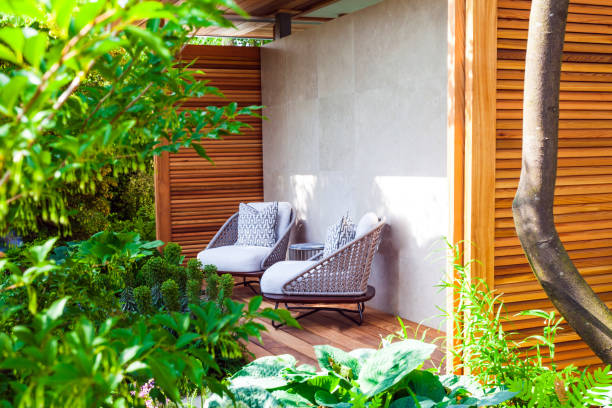
Building a great spa corner in your garden can be done in a very small space – around 3 by 3 metres – you just need to focus on one main feature instead of trying to squeeze everything in. So the idea is to pick one main item to be your anchor (like a small sauna, a compact hot tub, or a little area for soaking), put it out of sight from neighbors for privacy, and install a level, well-drained floor before you start adding other things. Less is more in little gardens.
People often make the biggest mistake by thinking that a spa corner is just a mini version of a luxury resort. It isn’t. With a small British garden, it’s simply creating a cozy, private spot that seems to be separated from the rest of the garden and is comfortable to use all year round, come rain or shine. If you do the right groundwork, the right screening, and the right heating, a corner with just a few square metres can give you a much better experience than a large patio that never feels intimate.
How much space do you actually need for a garden spa corner?
I think it’s much less than what most people think. For instance, a two-person barrel sauna takes roughly two square meters only. Besides a compact four-seat hot tub comfortably occupying a base of about four to five square meters after you take into account a step and a towel bench. Allow a bit of circulation room and you will have a usable corner of approximately six to nine square meters, which is achievable even on a modern new-build plot.
The limitation is rarely the spa unit itself. Rather it’s all the surroundings. You need a place to get out of without ending up in the mud, a place to hang towels and robes, and if possible, a small ledge for a drink or a speaker. Think about those margins first, because a hot tub crammed tightly to two fences with no standing room becomes a misery to get in and out of and of course, nobody uses things they find a hassle.
If floor space is limited, verticality can be your helper. For example, slatted screens, pergola overhead, and wall-mounted hooks will allow you to construct privacy and storage upward rather than diminishing the footprint. When dealing with a small garden, the area above waist height is where you make your gain.
What groundwork and drainage does a spa corner need?
It’s this unattractive aspect that determines whether the whole thing works or not. A hot tub with water and people inside can weigh two to three tonnes, so it will require a level, load-bearing base which, most of the time, is a reinforced concrete slab at least 100mm thick or correctly laid paving on a compacted sub-base. A sauna is lighter but still needs a flat stable well-drained surface so that the wood is not in contact with standing water.
Drainage is more important in Britain than almost anywhere else because the soil surface is wet most of the time and the unit will give off splash water and condensation. A small decline from the cabin or tub, together with a gravel buffer or a channel drain, will prevent the area from becoming a swamp. If you ignore this, you will be struggling with algae, decay, and slippery decking after a year.
Electrical installations are something that must not be overlooked either. Most of the hot tubs and electric saunas require a dedicated supply, and quite a few require a 32-amp or bigger circuit that is installed by an electrician who is qualified and registered under Part P building regulations. Put aside several hundred pounds for the wiring and paperwork, and do this at the same time as the groundworks instead of finding a way to do it later. Doing it after the slab is down is expensive and messy.
Which spa feature suits a small British garden best?
For many small gardens, an outdoor sauna is the simplest option. It takes up very little space, runs on less electricity than a hot tub since it only needs power during sessions, and it’s In particular enjoyable during the long British autumn and winter when the contrast with cold air is the main attraction. A two or three-person, cabin or barrel type can be placed in a space where a tub wouldn’t fit. The tradition of the sauna is built around exactly this hot-to-cold contrast, which is part of why it suits the British climate so well.
If you need the corner to be a sociable and family-friendly area, warm water is something kids and guests can enjoy together, so hot tubs will be more suitable for you. The downside, though, is the running cost and maintenance, as you have to keep hundreds of litres at a constant temperature throughout the year and adjust the chemicals on a weekly basis. In a small garden that doesn’t get much winter sun, these expenses increase just when you most want to be using it.
When you are choosing an actual cabin, insulation and timber quality matter far more than the brochure photography, especially in a damp climate, which is why it pays to look at British-made garden buildings designed for the weather here, like those from Edenhut, rather than a thin imported flat-pack. A well-insulated cabin heats faster, holds temperature longer, and survives British winters without warping, and on a small plot where the unit is always in view, build quality is also what makes the corner look intentional rather than bolted on.
How do you make a small spa corner feel private and year-round?
Privacy is what transforms the open unit into a real sanctuary. With a slatted timber screen, trellis covered with evergreens such as star jasmine or clematis, or even a line of bamboo in planters, one can block the sightlines from the neighbor’s windows without the need for planning permission provided the fence heights are kept within the usual two-meter limit. The idea is to block only the specific angles that overlook you instead of putting up walls all around the corner since this would make a small space feel like a box.
Year-round use of an outdoor spa is all about having some protection from the weather and warmth underfoot. A pergola or a simple lean-to roof can keep the rain off so you can get from the house to the spa even in winter, while outdoor-rated, warm dimmer lighting makes it possible to spend even the darkest evenings outside which in Britain, is almost the whole day for half the year. Decking made from composite or grooved hardwood will be less slippery than smooth slabs when wet and will last longer.
Sensory details are the ones that remain in people’s memories. A soft, low-level light instead of one harsh floodlight, a bench in a sheltered position, a heater, or a chiminea nearby to warm up after, and planting that smells nice in the evenings – these all turn a corner into a spot where one chooses to spend one’s time. As the industry, the gardens people actually use tend to be those that provide comfort even in marginal weather and not just on the dozen perfect days a year.
What does a small garden spa corner cost to build?
Budget realistically and expect the costs to vary widely based on your main feature (anchor). A fairly simple scheme centred on a small electric sauna, with a paved base, very basic screening, and electrics, can be done for about 5,000 to 9,000 pounds total. However, a hot-tub-based corner with a proper base drainage screening and a dedicated supply will more often than not work out to be in the region of 8,000 to 16,000 pounds once installation is factored in.
The secret expenses are usually the ones that get you the most. Groundwork and a reinforced base simply can cost anywhere from a few hundred to a couple of thousand pounds without the electrical work which will add a few hundred more. Also screening lighting, and decking will slowly and silently gather a large total. Splitting the project over a season, first doing the slab work and electrics, then bringing in the unit and adding the finishing touches, will not only make the expenditure more manageable but the result will also be much more thoughtfully completed.
You can begin by standing on the corner you have in your mind on a grey, damp afternoon. The reason being that this is the type of weather that your outdoor space will be subjected to most of the time/ if you decide to proceed with the project. If even in these conditions the place does not only come across as being quite protected but also as a place where one would want to be, then you will have a great time there during the summer and it will be well used in February/further still it will be the actual test of whether or not the investment was worth making/.
