


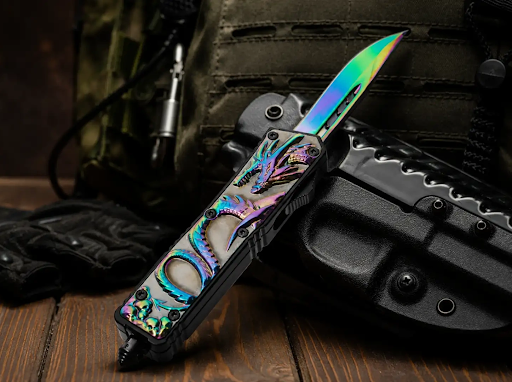
Few tools draw as much interest among knife enthusiasts as OTF knives and butterfly knives. Both are known for their mechanical design, smooth deployment, and strong following among collectors, outdoor hobbyists, and people who appreciate tactical gear. This guide covers how each type works, what materials and features matter, where they fit in outdoor and camping use, and what to consider before buying one.
Understanding OTF Knives and Their Appeal
OTF stands for “out the front.” In this design, the blade slides straight out of the front of the handle instead of pivoting from the side like a folding knife. Collectors often explore this category through a custom switchblade, since many modern automatic knives are built around the same front deploying mechanism. The appeal comes from engineering. A spring driven track moves the blade in a straight line, and a well made OTF locks into place with a firm, satisfying feel.
OTF knives come in two broad forms. Single action models deploy the blade with a button or slider but need manual effort to retract it. Double action models both extend and retract the blade through the same control. Each has its fans, and the choice often depends on how you plan to use the knife and how much mechanical complexity you want to maintain.
How the Mechanism Works
The internal workings of an OTF knife are a good example of compact mechanical design. A spring sits inside the handle and stores energy when the blade is retracted. When the user moves the actuator, the spring releases and pushes the blade forward along guided tracks. A locking system then holds the blade in place so it does not wobble or slip during use.
Quality varies widely across brands. Better knives use tight machining tolerances, hardened internal parts, and carefully tuned springs. Cheaper models may show blade play, sticky deployment, or weak retraction. When evaluating an OTF knife, check for a clean, consistent action, minimal side to side movement of the blade, and a lock that feels solid every time.
Butterfly Knives and the Balisong Tradition
Butterfly knives, also called balisongs, work very differently. They have two handles that rotate around the blade. When closed, the blade rests inside channels in the handles. When opened, the handles swing around and meet behind the blade, forming a single grip. A latch holds the knife closed, and a locking mechanism secures it when open.
Balisongs have their roots in the Philippines, where they became part of the country’s cultural and martial heritage. Today they are popular largely because of flipping, a hobby that involves performing fluid opening, closing, and manipulation tricks. Many enthusiasts use blunt practice versions called trainers before moving up to a sharpened knife. Because the handles move so freely, learning proper technique and respecting the blade is essential.
Materials, Finishes, and Customization Options
Material choice has a major impact on how an OTF or butterfly knife performs and how long it lasts. Blades are commonly made from stainless steels such as 440C, D2, or modern powder steels, each balancing edge retention, toughness, and corrosion resistance differently. Handles are usually aluminum, titanium, or reinforced polymer, with aluminum being popular for its balance of low weight and durability.
Personalization is a big part of the hobby, and a custom OTF knife lets buyers choose blade shape, handle color, finish, and sometimes engraving to match their preferences. Common blade styles include drop point, tanto, and dagger profiles, each suited to different tasks. Coatings such as black oxide, titanium nitride, and cerakote add visual appeal and some resistance to wear and rust. Choosing the right combination helps a knife suit both your intended use and your personal style.
Outdoor, Camping, and Tactical Uses
Folding knives are usually the first choice for camping, but OTF knives do have a place in outdoor kits. They are compact, easy to carry on a belt or in a pocket, and can be deployed quickly with one hand. That makes them handy for light tasks like cutting cordage, opening packaging, preparing kindling, or slicing food at camp.
That said, OTF mechanisms have limits. Dirt, sand, moisture, and debris can interfere with the internal tracks, so these knives suit controlled or lightly demanding conditions better than heavy bushcraft. For batoning wood or rough field work, a fixed blade is still the more dependable tool. Many experienced campers carry an OTF or folder as a secondary knife alongside a sturdy fixed blade, which gives them both convenience and strength.
In tactical and military themed circles, OTF knives are valued for their rapid deployment and compact profile. Collectors often appreciate them as examples of precision manufacturing as much as functional tools.
Legal Considerations and Safe Handling
Before buying any OTF or butterfly knife, learn the laws that apply where you live. Regulations on automatic knives and balisongs differ greatly between countries, states, and even cities. Some areas restrict ownership, others restrict carrying in public, and some set limits on blade length. Always check local and national rules, and keep in mind that travel between jurisdictions can change what is legal.
Safe handling matters just as much. Keep fingers away from the blade path, store knives out of reach of children, and never practice flipping or deploying a knife while distracted. Using a trainer for butterfly knives and learning basic control before moving to a sharpened blade reduces the risk of injury.
Maintenance and Long Term Care
Regular care keeps an OTF or butterfly knife working smoothly. Periodically clean the blade and handle with a soft cloth and remove dust or lint from the openings. A small amount of quality lubricant applied to the tracks, pivots, or bushings helps maintain smooth action, but avoid overapplying, since excess oil attracts grit.
Inspect screws and fasteners from time to time, particularly on balisongs, where loose pivots can cause handle play. Keep the blade sharp with a proper sharpening system, and store the knife in a dry place to prevent corrosion. A little routine attention can extend the life of a good knife by many years.
Conclusion
OTF knives and butterfly knives combine mechanical ingenuity, craftsmanship, and practical utility in a way that appeals to collectors, hobbyists, and outdoor enthusiasts alike. Understanding how each mechanism works, which materials suit your needs, and what the law allows in your area will help you make a confident purchase. Handled responsibly and maintained well, these knives can be rewarding tools and long lasting additions to any collection. For more details on OTF and butterfly knife options, visit https://www.otffactory.com/.
