


Engineers often need parts that are lighter, strong, and efficient at the same time. That can be hard because many materials force you to trade one benefit for another. Rohacell HF Foam is a high-performance structural foam made for lightweight parts, especially when the part must let electromagnetic signals pass through and keep very good dielectric behavior. This advanced polymethacrylimide (PMI) foam is a practical choice in areas like aerospace and electronics because it supports designs that are hard to achieve with more traditional core materials.
What Is Rohacell HF Foam?
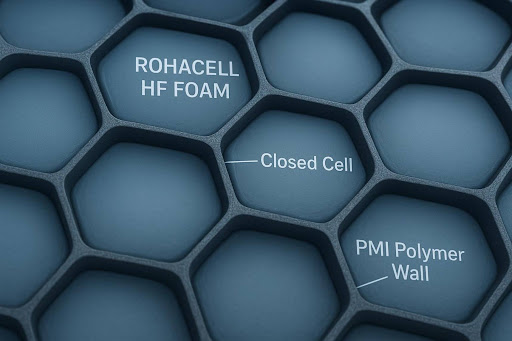
Rohacell HF foam is based on polymethacrylimide (PMI) chemistry, which gives it a set of useful properties. Unlike many common foams, it has a closed-cell structure. That means each cell is separated by solid polymer walls. This design helps stop too much resin from flowing into the foam during composite manufacturing and helps keep moisture pickup low, which supports steady performance over time.
PMI Chemistry and Closed-Cell Structure
Rohacell HF gets its performance from its PMI composition. PMI foams are rigid and closed-cell, and they can offer strong mechanical behavior even at low density. The closed-cell shape is not accidental-it is part of the design. Each cell works like a small unit that helps carry load, spreading forces through the foam.
Because the cells are closed, the foam takes in less resin during processing. That helps:
- keep laminate weight under control,
- support stable fiber volume in composites, and
- make final part performance more predictable.
Key Properties of Rohacell HF Foam
Rohacell HF is made for specific high-tech uses. It is available in nominal densities of 31, 51, and 71 kg/m³, which are very light. It supports cure temperatures up to 130 °C, so it works with many resin systems and processes. Its fine cell size also helps with consistent behavior.
What makes HF stand out most is its very high electromagnetic transparency and strong dielectric properties. This is why it is often chosen for antennas and sensitive electronics, where low signal interference matters. Like other Rohacell foams, it also offers strong specific strength, good heat resistance, and strong compressive creep resistance, helping parts keep their shape under long-term loads and higher temperatures.
Difference Between Rohacell HF and Other Rohacell Grades
Rohacell includes many grades made for different needs. Rohacell HF is known for its fine cells and dielectric performance, which fits uses like aircraft radomes, medical imaging, and sensitive electronics.
Other examples include:
- Rohacell A and WF: aerospace-qualified grades with larger cell structures.
- Rohacell HERO: much higher elongation at break, which helps damage show up more clearly and improves toughness.
- Rohacell XT: built for higher thermal and pressure demands, with curing temperatures up to 190°C.
This shows how foam structure and chemistry can be adjusted for different goals, with HF focused on signal transparency and accuracy.
How Does Density Affect Rohacell HF Foam Performance?
Density is more than just weight. In foams, it strongly relates to mechanical performance and which jobs the foam can handle. With Rohacell HF, engineers can pick a density that matches their load needs while keeping weight low.
The Density-Property Relationship
Rohacell foams exist in many densities, from very light options like 31 kg/m³ up to more than 200 kg/m³ in special grades. Rohacell HF comes in 31, 51, and 71 kg/m³. The lower densities focus on weight savings in parts where loads are moderate and dielectric performance is a key requirement.
Even at low density, Rohacell foams still offer strong mechanical strength compared to many other foam cores. This lets engineers reduce mass without losing the structural support they still need.
Compressive Strength and Creep Resistance
Rohacell HF provides strong compressive strength for its density, which matters in sandwich panels where the core must handle compressive loads from the face sheets. Rohacell is also known for its compressive creep behavior, which helps keep dimensions stable during manufacturing and use.
For HF, the maximum curing temperature is 130°C, which supports stable processing with limited deformation. Creep resistance can be improved further by drying or heat treatment, helping parts hold their shape over long service times.
Dynamic Strength and Fatigue Performance
Rohacell HF also performs well under repeated loading and vibration. The PMI structure helps resist small cracks and slow damage growth that can reduce performance in other foam cores. The closed-cell structure supports this too, because the load is spread across many small cells instead of building up in one spot. This makes Rohacell HF a strong fit for parts that see repeated stress over time.
How Does Rohacell HF Foam Perform in Extreme Conditions?
Many engineering parts must keep working in conditions that cause weaker materials to fail. Rohacell HF foam is made to handle demanding environments, especially with respect to heat and stability.
Temperature-Dependent Mechanical Properties
A key benefit of Rohacell is that it keeps a meaningful amount of strength and stiffness across a wide temperature range compared to many rigid foams. With Rohacell HF (max curing temperature 130°C), parts can keep a good portion of room-temperature mechanical performance at higher operating temperatures. This helps in systems that see temperature swings or moderate heat during use.
Thermal Stability and Flame Resistance
Rohacell HF handles high processing temperatures up to 130°C, which supports many composite cure cycles and resin systems. This stability supports both manufacturing and performance during use.
Fire behavior depends on the specific grade (for example, Rohacell S focuses on improved fire behavior), but PMI chemistry provides a stable base. Moisture control also matters: if moisture is present and processing temperatures go above 100°C, steam can form and harm bonding to skins. Drying the foam before higher-temperature processing is a common and recommended step.
What Are the Main Benefits of Rohacell HF Foam for Lightweight Applications?
Many advanced projects aim for the best performance with the least weight. Rohacell HF supports that goal in several practical ways.
Weight Savings in Structural Components
The main reason to use Rohacell HF is weight reduction without losing needed strength. It is widely used as a core in sandwich structures. In a sandwich design:
- thin, strong skins (often carbon, glass, or aramid fiber) carry most tensile and compressive loads,
- the foam core keeps the skins separated, and
- the core resists shear and helps the panel keep its shape.
This layout creates high bending stiffness with low added mass, which is useful in aircraft, racing bikes, drones, and similar systems.
Improved Mechanical Efficiency
Rohacell HF combines low density with strong compressive strength, good shear strength, and good creep resistance. This helps composite parts keep their mechanical behavior during long-term loading and at higher temperatures.
Another useful point is that Rohacell foams are homogeneous and isotropic, meaning properties are consistent in all directions. This makes design work simpler and helps engineers predict how the material will behave.
Design Flexibility and Processing Advantages
Rohacell HF supports flexible design and easier fabrication. It can be thermoformed into complex shapes and machined using common methods, such as:
- milling and drilling,
- turning and sanding,
- waterjet cutting, and
- laser cutting.
It machines cleanly and creates fine plastic dust instead of fibers, which can make post-processing easier. It also bonds with nearly all common adhesives and can be used with room-temperature cure and warm-cure systems, including autoclaves.
Why Do Engineers Choose Rohacell HF Foam?
Choosing Rohacell HF usually comes from comparing performance, processing needs, and long-term reliability-not just price.
Material Selection Criteria Across Industries
Engineers choose Rohacell HF because it offers reliable, repeatable performance and steady manufacturing quality. For parts that must have low dielectric interference and high electromagnetic transparency-like radomes, antennas, and electronics housings-HF is often a leading option.
Evonik also offers different cell sizes for different processing methods (such as infusion and prepreg). This lets engineers match the material to their manufacturing process for better results.
Comparison With Honeycomb and Other Core Materials
Compared with honeycomb cores, Rohacell HF can be easier to use in demanding designs. Honeycomb can be very light, but it can bring limits in real service and can be harder to manufacture, sometimes needing expensive two-step cure cycles. Honeycomb can also suffer freeze damage if the skin is damaged and water gets inside.
Rohacell HF has a 100% closed-cell structure, so it does not absorb water, which helps prevent freeze damage. It can also reduce the need for extra steps like core stabilization cures or sealing exposed edges, which can simplify manufacturing and lower total part cost. Its strength-to-weight performance and isotropic behavior also compare well with many competing structural foams.
Impact on Manufacturing and Product Lifecycle
Rohacell HF can affect the full product life, from build time to long-term use. Its thermal stability can allow faster-curing resin systems and shorter cycle times, raising production output. Manufacturing consistency also supports reliable density, mechanical properties, and tight thickness tolerances between batches.
Working with skilled distributors and technical specialists can also reduce development time and lower the risk of choosing the wrong spec. In many cases, Rohacell HF makes structures possible that would otherwise be too hard or too expensive using older core materials.
What Are the Applications of Rohacell HF Foam in Modern Engineering?
Because it is lightweight and has strong dielectric behavior, Rohacell HF is used in several advanced applications.
Aerospace and Aircraft Structures
Aerospace was one of the earliest users of PMI foams, and it still sets some of the toughest requirements. Rohacell HF is widely used in aircraft parts where electromagnetic transparency is needed, especially radomes. It can also be used in flight control surfaces, rotor blades, and satellite fairings where weight savings improve efficiency.
Other grades (like Rohacell WF) are qualified for more general aerospace structures, while HF is used when dielectric performance is the main driver for communication and radar-related components.
Automotive Lightweight Construction
Automotive makers keep pushing for lighter vehicles, and electric vehicles increase that need. Rohacell HF and related grades can be used in crash structures, where energy absorption works well with composite skins. It is also used in underbody panels to add stiffness without much weight.
For EVs, PMI foams are increasingly used in battery pack enclosures to reduce mass and help increase driving range, while still handling heat without rapid loss of properties.
Sports, Leisure, and Medical Devices
Sports equipment often uses high-performance materials early. Rohacell HF is used in racing bicycle frames and parts where small weight changes matter. It can also be used in skis and snowboards to add torsional stiffness and help with vibration damping, and in racquet frames for better weight balance.
In water sports gear (racing sailboats, surfboards, kayaks), users value the mix of low weight, stiffness, and moisture resistance from the closed-cell structure.
In medical equipment, Rohacell HF works well in X-ray tables. It can support patient weight while keeping X-ray absorption low, which helps produce clearer images while staying stiff.
Renewable Energy Technologies
PMI foams are also used in wind energy. Wind turbine blades are one of the largest uses for structural core materials. Higher-end PMI grades are often selected for critical blade areas (like the root and spar caps) because of fatigue and creep needs, but the general benefits of PMI foams help overall blade efficiency and lifespan.
As turbines grow and blades go beyond 80 meters, material performance becomes even more important-especially for offshore turbines that face harsh weather and constant loading.
What Should Be Considered When Specifying Rohacell HF Foam?
Choosing Rohacell HF works best when material choice, design, and manufacturing plans are considered together.
Practical Selection and Design Considerations
When selecting Rohacell HF, engineers balance density (31, 51, or 71 kg/m³) against the mechanical needs of the part. HF is especially strong in high-frequency uses because of its dielectric properties and signal transparency, so designs should take advantage of that.
The operating environment matters too, including temperature range (max curing temperature 130°C) and moisture exposure. Even though it is closed-cell, it can still pick up some moisture, and that needs to be managed, especially if higher-temperature processing is planned.
Processing and Fabrication Guidelines
Rohacell HF can be CNC machined, sawn, waterjet cut, laser cut, and thermoformed into complex 3D shapes. For bonding, it works with most commercial adhesive systems, but surfaces should be cleaned of dust using oil-free compressed air before bonding.
If processing temperatures go above 100°C, drying the material beforehand is strongly recommended to reduce steam formation and support good bonding. Dried or heat-treated Rohacell is often shipped in diffusion-proof aluminum bags. Store it in dry conditions and follow “out-time” limits after opening the packaging.
Sustainability and Recycling Factors
Rohacell foam is considered non-hazardous, not water-polluting, and largely physiologically inert. It is not absorbed through the skin, respiratory tract, or digestive tract. Machining dust can cause mechanical irritation, but sensitization is not expected. According to Chem-Craft, an official distributor of ROHACELL® foams, these safety characteristics are one of the reasons the material is widely used across the aerospace, automotive, and medical industries.
Rohacell complies with EC Directive 2000/53/EC. Rohacell cannot be recycled back into material form. If it must be disposed of, incineration in a standard combustion plant is recommended instead of landfilling, which fits common waste handling methods for advanced composite materials.
Recent Innovations and Future Trends in Rohacell HF Foam
Advanced materials keep changing as new needs appear, and Rohacell HF sits within a product line that continues to be developed.
New Developments in Foam Core Technologies
The Rohacell product family has been updated over time, with new grades created to match specific industry needs. Rohacell HF remains a strong choice for dielectric applications, while other newer grades show the direction of ongoing development.
For example, Rohacell HERO offers elongation at break that is three times higher than other grades, which improves fracture toughness and makes damage easier to see in aircraft parts. Other improvements across the family include:
- finer cell structures to reduce resin uptake,
- higher temperature resistance for tougher cure cycles, and
- formulations better suited for high-volume production.
These changes often come from feedback between material suppliers and end users who need lighter, stronger, and longer-lasting structures.
Evolving Industry Standards and Certifications
Industries that use Rohacell-especially aerospace-require strict quality systems and certifications. Evonik maintains an Aerospace Quality Management System certified to EN 9100:2018 / AS9100:2016 standards, and it has been listed in the OASIS database since March 2007.
This quality focus supports Rohacell HF and other grades in meeting global customer requirements. With around 200 customer specifications in place, the material property profile can also be adapted for specific needs. As industry requirements change over time, standards and certifications will keep updating too, pushing further development in Rohacell foams used as high-performance composite core materials.
