


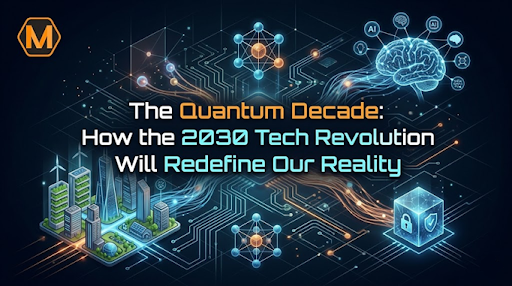
The year 2030 often feels like a distant chapter in a science fiction novel, yet the blueprints for that era are being drawn today. We are standing on the precipice of a shift so fundamental that it will rewrite how we interact with the physical and digital worlds. Unlike the mobile revolution of the 2010s, which changed how we communicate, the coming decade is about “Quantum Intelligence”—the fusion of near-limitless processing power with autonomous systems that can predict, rather than just react to, human needs.
As we navigate this transition, the way we acquire knowledge and demonstrate expertise is undergoing a massive transformation. Students and professionals are moving away from rote memorization toward high-level data synthesis and ethical oversight. This shift has created a massive demand for specialized academic support, where services providing University Assignment Help through myassignmenthelp have become essential anchors for those trying to master complex future-tech curricula. By delegating the heavy lifting of documentation and formatting, the next generation of innovators can focus on the creative problem-solving required to manage a world run by qubits and neural networks.
The Rise of Quantum Supremacy
For decades, our computers have spoken the language of “bits”—simple ones and zeros. But by 2030, quantum computing will have moved from experimental laboratories into the heart of global industry. Using “qubits,” these machines can exist in multiple states at once, allowing them to solve calculations in seconds that would take today’s fastest supercomputers thousands of years. This isn’t just about speed; it’s about solving the “unsolvable.”
Imagine a world where drug discovery takes days instead of decades. By simulating molecular structures at a quantum level, scientists will be able to “design” cures for chronic diseases with pinpoint accuracy. Similarly, our global logistics and supply chains will be optimized by quantum algorithms that predict weather patterns and traffic flow with 99% accuracy, virtually eliminating waste and reducing the carbon footprint of global trade.
Comparing the Eras: Classical vs. Quantum Computing
| Feature | Classical Computing (Current) | Quantum Computing (2030 Projection) |
| Basic Unit | Bit (0 or 1) | Qubit (Superposition of 0 and 1) |
| Processing Style | Linear / Sequential | Parallel / Simultaneous |
| Data Security | RSA Encryption (Vulnerable) | Quantum Key Distribution (Unbreakable) |
| Best Use Case | Everyday Apps, Web Browsing | Molecular Modeling, Complex Optimization |
| Energy Needs | High for Supercomputing | Targeted, but requires Cryogenic Cooling |
Agentic AI: From Assistants to Partners
We are already familiar with basic AI that can write a poem or generate an image. By 2030, we will have moved into the era of “Agentic AI.” These are not just chatbots; they are autonomous agents capable of executing multi-step projects without constant human prompting. Your AI agent will manage your schedule, negotiate your energy bills, and even pre-screen your research data.
In the professional world, this means the “entry-level” job will look very different. Instead of spending hours debugging code or proofreading reports, young professionals will act as “AI Architects.” For those learning the ropes of complex technical languages, utilizing specialized Java Assignment Help is becoming a standard way to bridge the gap between classroom theory and the high-speed demands of the modern tech industry.
The Cybersecurity Pivot: Preparing for “Q-Day”
One of the most significant, yet hidden, changes by 2030 will be how we protect our data. Experts often refer to “Q-Day”—the hypothetical moment when a quantum computer becomes powerful enough to break traditional RSA encryption. This sounds like a digital doomsday, but it is actually driving a massive wave of innovation in post-quantum cryptography.
By the end of this decade, our digital identities will be shielded by “Quantum Key Distribution” (QKD). This technology uses the laws of physics to ensure that any attempt to intercept a message immediately alters the data, making it unreadable to hackers. It will be a world where privacy isn’t just a setting on an app, but a fundamental property of the network itself. We will see the birth of an “un-hackable” internet, providing a level of security for banking, healthcare, and personal communication that was previously thought impossible.
Neuro-Performance and the Future of Productivity
The tech revolution isn’t just happening in our pockets and on our desks; it is moving into our biology. By 2030, the intersection of technology and wellness will give rise to “Neuro-Performance.” We are seeing the early stages of this with wearable tech that tracks sleep and heart rate, but the future holds non-invasive brain-computer interfaces (BCIs) that can help us optimize our focus and manage stress in real-time.
Productivity will no longer be measured by how many hours you sit at a desk, but by the “quality of output” and “cognitive efficiency.” In this high-stakes environment, the ability to synthesize vast amounts of information quickly will be the most valuable skill a person can possess. We are shifting toward a “Lifestyle of Optimization,” where every habit—from what we eat to how we learn—is backed by real-time data and AI-driven insights.
Sustainable Innovation: Solving the Energy Crisis
One of the biggest criticisms of the tech boom is its energy consumption. However, the 2030 revolution is deeply intertwined with the “Green Transition.” Quantum computing and AI are being used to discover new materials for high-capacity batteries and more efficient solar cells. By 2030, we expect to see “Smart Grids” that use AI to distribute renewable energy across cities with zero waste.
We are moving toward a circular economy where technology helps us track the lifecycle of every product. From the minerals in your smartphone to the fabric in your clothes, digital “passports” will ensure that everything is recycled and reused. This isn’t just a trend; it’s a structural change in how humans inhabit the Earth, moving from a model of consumption to one of harmony with our resources.
Navigating the Ethical Frontier
With great power comes the need for a new set of rules. As we approach 2030, the conversation around “AI Ethics” and “Digital Integrity” will move to the center of global politics. How do we ensure that AI doesn’t inherit human biases? How do we protect the rights of workers in an automated economy?
The 12th-grade students of today will be the policymakers of 2030. They are already learning that technology is not neutral; it is a tool that reflects the values of its creators. The focus is shifting toward “Responsible Innovation,” where the success of a new technology is measured by its benefit to society, not just its profit margins. This requires a deep understanding of both technical systems and human humanities—a multidisciplinary approach that is becoming the gold standard in modern education.
The Evolution of Skill Sets by 2030
To stay relevant in the coming decade, individuals must pivot from traditional skill sets to “Meta-Skills.”
- Prompt Engineering & Logic: The ability to communicate effectively with AI systems.
- Data Literacy: Understanding how to interpret and question the outputs of complex algorithms.
- Ethical Auditing: Evaluating the social impact of technological implementations.
- Rapid Adaptation: The “learnability” factor—being able to pivot as tools evolve.
Conclusion: Your Place in the New Era
The revolution of 2030 isn’t something that will just “happen” to us; it is something we are actively building. Whether it is through mastering the complexities of quantum logic, ensuring the security of our global networks, or finding new ways to integrate technology into our wellness routines, every individual has a role to play.
The key to thriving in this new decade is adaptability. The tools we use today will be obsolete in five years, but the ability to learn, unlearn, and relearn will remain timeless. As we look toward 2030, the goal is not to be replaced by machines, but to be empowered by them—to use the extraordinary processing power at our fingertips to solve the most pressing challenges of our time and create a future that is smarter, safer, and more sustainable for everyone.
By focusing on information gain and human-centric design, we can ensure that the tech revolution serves as a bridge to a better quality of life rather than a barrier to human connection. The future is waiting; it’s time to start writing the first chapter.
Frequently Asked Questions
What exactly is quantum computing?
Unlike traditional computers that process data in a linear fashion using bits, quantum systems use qubits. This allows them to perform millions of calculations simultaneously, solving complex problems in seconds that would currently take centuries.
How will AI change daily work by 2030?
Artificial Intelligence is shifting from simple tools to “autonomous agents.” These systems will be capable of managing entire projects, negotiating schedules, and conducting deep research with minimal human intervention, allowing people to focus on strategy and creativity.
Is my personal data safe from future tech?
While new computing power can challenge current encryption, the next decade is introducing “quantum-safe” security. This uses the laws of physics to create unbreakable communication channels, ensuring personal and financial data remains private even against advanced threats.
How does technology improve mental performance?
The intersection of biology and tech is giving rise to non-invasive interfaces that track cognitive load and stress. These tools provide real-time feedback to help individuals optimize their focus, improve sleep quality, and maintain high mental efficiency throughout the day.
